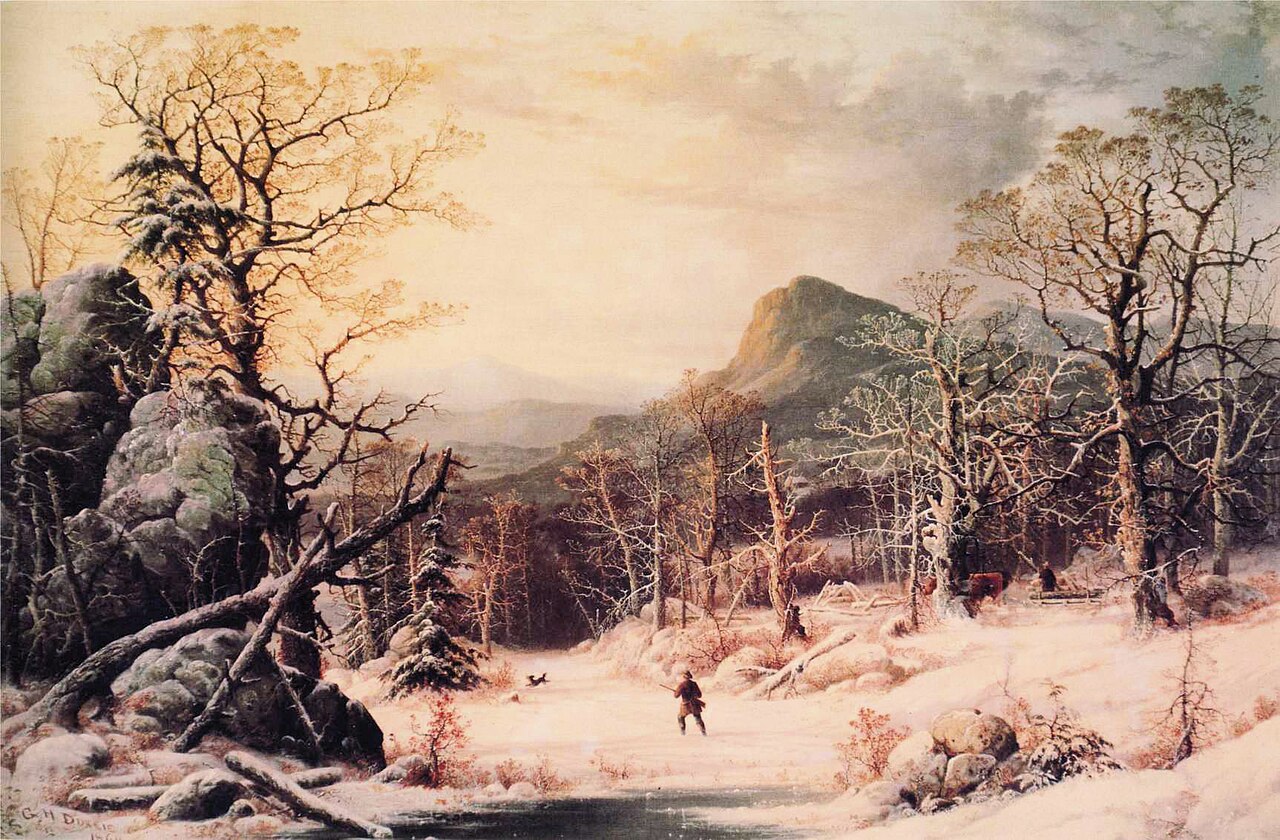
Stopping by Woods on a Snowy Evening
Robert Frost
Whose woods these are I think I know.His house is in the village though;He will not see me stopping hereTo watch his woods fill up with snow.
My little horse must think it queerTo stop without a farmhouse nearBetween the woods and frozen lakeThe darkest evening of the year.
He gives his harness bells a shakeTo ask if there is some mistake.The only other sound's the sweepOf easy wind and downy flake.
The woods are lovely, dark and deep.But I have promises to keep,And miles to go before I sleep,And miles to go before I sleep.
Why it's here
Robert Frost (1874–1963) is probably the most quoted American poet of the 20th century. Born in San Francisco, he spent most of his life on farms in New England, the landscape that runs through nearly all his work. Success came late: his first two books were published in England, when he was nearly 40. He went on to win four Pulitzer Prizes and read at John F. Kennedy’s inauguration in 1961. The Poetry Foundation (opens in a new tab) has a good profile.
Frost wrote this poem in June 1922, after staying up all night finishing a much longer one. When he stepped outside at dawn, it came to him in a few minutes. On the surface, it’s simple: a man pauses on a winter evening to watch snow fall in someone else’s woods, then remembers he has to keep going. Underneath, it’s about the pull between beauty and duty, between the lovely, dark stillness of the woods and the promises that drag us back to the world. Many readers also hear death in it, with “sleep” doing double duty in that repeated last line. Frost himself resisted that reading, but it’s hard to unhear. Look at the rhymes too: the odd line out in each stanza sets up the rhymes of the next, chaining the poem forward until the last stanza, where every line rhymes and the repetition finally lets it come to rest.
A nice Indian footnote: the poem was a favorite of Jawaharlal Nehru (opens in a new tab), who reportedly kept its last stanza close at hand until his death in 1964. Some say it was handwritten on his desk; others, that the lines were underlined in a book by his bed. Either way, the story was famous enough that Richard Nixon told it (opens in a new tab) at a White House dinner for Indira Gandhi, and when Joe Biden gave Narendra Modi a first edition of Frost’s collected poems in 2023, India read it (opens in a new tab) as a nod to Nehru. The poem even has a Hindi life: Harivansh Rai Bachchan (opens in a new tab), the poet behind Madhushala (opens in a new tab), translated those famous last lines as “Arey, abhi to milon mujhko, milon mujhko chalna hai.” B.